
The AWS re:Invent 2026 session catalog is live, and if you have opened it, you already know the feeling: thousands of sessions, dozens of tracks and a reservation system that makes you want to close the tab and hope for the best. Every year I go through the catalog so I can build my own agenda, and every year I share the result with the community so you can skip most of that work.
The challenge is not a lack of good content but the opposite, because there is so much of it that great sessions get lost among the ones that only rephrase a product page, and this year almost every other session title contains the word "agent."
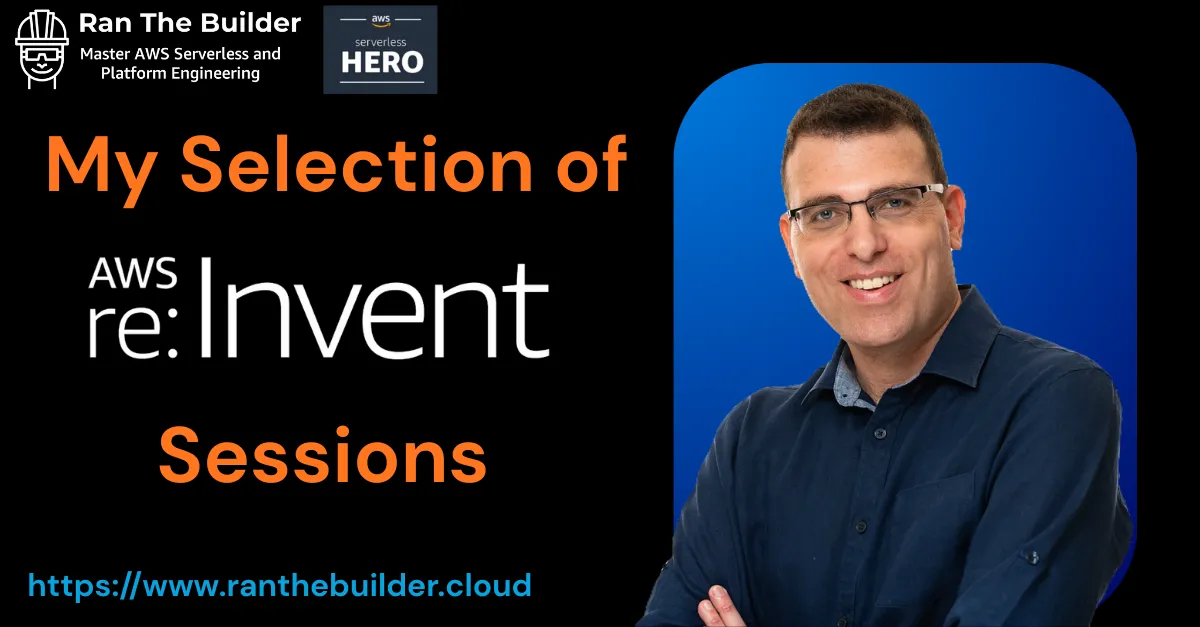
In this post, you will learn which AWS re:Invent 2026 breakout sessions, workshops, builders' sessions, code talks, chalk talks, bootcamps and labs I recommend for serverless, agentic AI, platform engineering and security, and you will get my full list in the unofficial re:Invent planner so you can add every session to your own agenda in one click.
My AWS re:Invent Guide
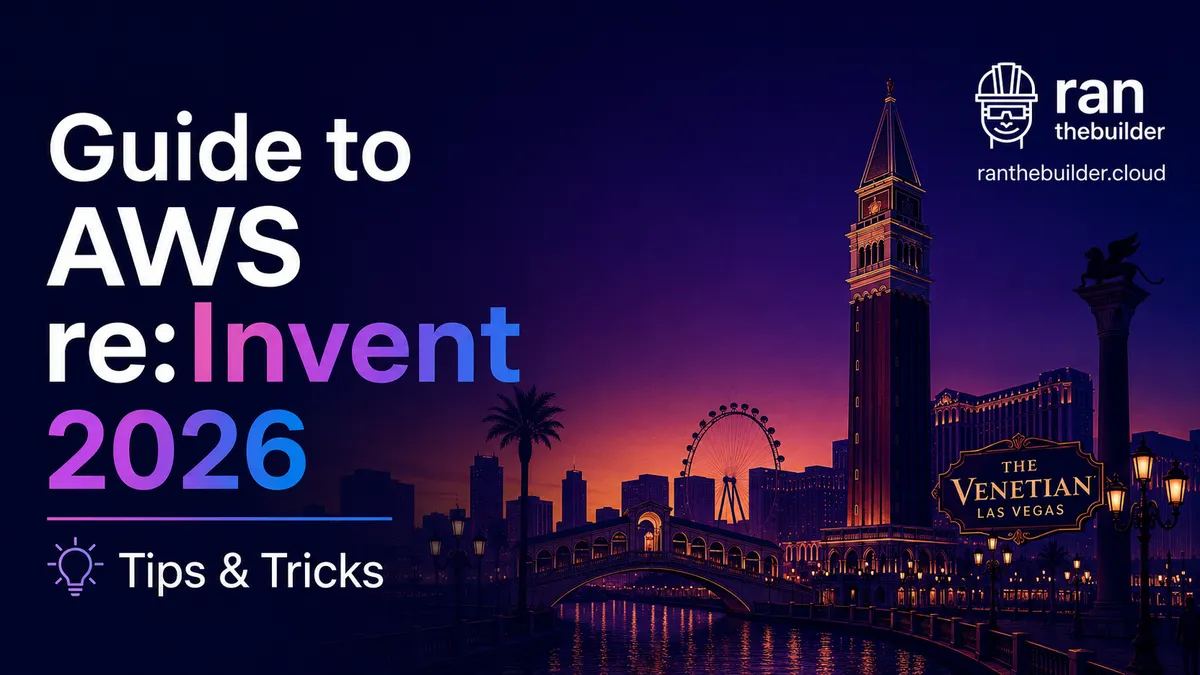
If this is your first re:Invent, or your tenth, start with my guide to AWS re:Invent 2026, with tips and tricks. It covers how to build your session agenda, what to do in Vegas and, of course, shopping. Once you know how the week works, come back here and pick your sessions.
Use the Unofficial re:Invent Planner and Grab My List
Before we get to the sessions themselves, a quick recommendation about tooling. The official catalog works, but for building an agenda I much prefer the unofficial AWS re:Invent session planner, a community built tool that makes it far easier to search, filter by level and type, see conflicts on a calendar view and share lists with friends and colleagues. Use it to plan, and then reserve your seats in the official portal.
I have added every session from this post to a shared list called "AI & Serverless By AWS Hero Ran Isenberg," which you can open here: my re:Invent 2026 session list in the unofficial planner. Take it, remove what does not interest you and add your own picks.
AWS re:Invent 2026 Keynotes
Keynotes are where AWS leadership announces new services and features, and while you can watch them live from the comfort of your hotel room, I recommend attending at least one in person for the atmosphere. Come early, since the lines get long.
This year there is a big change: there is no Werner Vogels keynote. Werner's keynote was a highlight of re:Invent for years and usually took place on Thursday, and AWS will fill that slot with something new, which I am very curious about and suggest you keep an eye on. As for the rest of the week, the CEO keynote usually takes place on Tuesday morning. The official 2026 keynote schedule and speakers are coming soon, so check the re:Invent keynotes page as the event gets closer.
re:Invent Session Types
Now that we have the big stage covered, let's talk about the session formats you will find in my list, because the format matters as much as the topic when you plan your week.
- Breakout sessions are lecture style sessions of about an hour, delivered by AWS experts, customers or community speakers. They are recorded and published on YouTube, so prioritize the interactive formats if your agenda is tight.
- Chalk talks are highly interactive, whiteboard based sessions with a small audience, where the discussion and your questions matter more than the slides. They are not recorded.
- Code talks are live coding sessions where the speakers build and explain real code in front of you.
- Workshops are two hour hands-on sessions where you work in small teams on a real problem, so bring your laptop.
- Builders' sessions are small group, hands-on sessions where an AWS expert sits at your table and guides you as you build. Bring your laptop.
- Bootcamps are longer hands-on training sessions, several hours in length, that teach a method or skill end to end.
- Labs are guided, self paced hands-on exercises in a prepared environment.
re:Invent Session Levels
Every session has a level, from 100 (foundational) through 200 (intermediate), 300 (advanced) and 400 (expert), up to 500 (distinguished). My recommendation is to target level 300 at a minimum. Introductory content is easy to find online, while the advanced and expert sessions are where you get the trade-offs, the production war stories and the chance to ask questions of the people who built the services. That is why my list starts at level 300 this year, with no 100 or 200 level sessions at all.
Below, the sessions are sorted by level and then by day and time, so you can plan your week from top to bottom. Community sessions are marked with a star.
My AWS re:Invent 2026 Breakout Session
Before the list, allow me a small plug. This year I am presenting a breakout session in the community track together with my friend Stav Ochakovski, and we would love to see you there.
COM401 | Breakout Session | AI Didn't Wait for Security: Now What?
⭐ Community session, highly recommended!
Location: Wynn/Encore
When: Monday, Nov 30, 11:30-12:30
That's my session with Stav! See the section above for all the details.
Developers already ship code with agentic AI, coding assistants and MCP servers, often without any governance, and blocking them only lowers efficiency and leaves you behind. In our session, we break down the architecture of a governed AI platform: a centralized MCP broker built with Amazon Bedrock AgentCore Gateway and Runtime, how agent requests gain identity and permissions, a curated agentic skills catalog with reusable blueprints and AI SDLC frameworks with DevOps and security agents built into key stages.
Level 300 Sessions: Serverless, Agentic AI and Architecture
DVT310 | Chalk Talk | Agentic development with AWS Cloud Development Kit (AWS CDK)
Speakers: Momo Kornher
Location: Caesars Forum, Level 1, Academy 409
When: Monday, Nov 30, 08:30-09:30
Official agenda: DVT310 in the AWS re:Invent 2026 session catalog
AI coding agents can write application logic, but can they provision your infrastructure too? In this chalk talk, explore AWS Cloud Development Kit's (AWS CDK) latest capabilities—Mixins, the CDK Toolkit Library, and programmatic synth/deploy APIs—make CDK a first-class target for agentic workflows. See how agents reason about constructs, compose infrastructure from natural-language intent, and validate results before deployment. We'll discuss patterns that work, guardrails that keep agents safe, and where human judgment still matters. Bring your questions—this is an interactive session for anyone curious about the intersection of AI agents and infrastructure as code.
SVS323 | Chalk Talk | Orchestrating agentic workflows: Step Functions & durable functions
Speakers: Dan Ronald, Rohan Mehta
Location: Caesars Forum, Level 1, Forum 114
When: Monday, Nov 30, 12:00-13:00
Official agenda: SVS323 in the AWS re:Invent 2026 session catalog
AI agents need orchestration that handles long-running tasks, human approvals, and recovery from partial failures. In this chalk talk, compare AWS Step Functions and Lambda durable functions for agentic workloads, and learn when to choose code-first, replay-based recovery versus visual state-machine semantics. We’ll whiteboard how durable functions checkpoint progress and resume after failures, how Step Functions handle branching and parallel tool calls, and where Lambda MicroVMs fit for sandboxing agent-generated code execution. Bring your architecture questions—we’ll design hybrid patterns that combine both orchestrators based on your workload shape.
SVS303 | Workshop | AI-driven serverless development with Kiro
Speakers: Giedrius Praspaliauskas, Mike Ellis
Location: Caesars Palace
When: Monday, Nov 30, 12:00-14:00
Official agenda: SVS303 in the AWS re:Invent 2026 session catalog
What if an AI assistant could apply serverless patterns and best practices to help you build production-ready code faster? In this workshop, use Kiro to create a serverless application with authentication, tests, observability, and an optional CI/CD pipeline. Along the way, your AI assistant reviews and explains code, looks up configuration settings, and generates tests—accelerating your development workflow while teaching you serverless fundamentals. Whether you're new to serverless or looking to boost productivity, you'll walk away with a working application and practical AI-assisted development techniques. You must bring your laptop to participate.
ARC312-R | Workshop | Multi-agent AI: Orchestration and choreography, compared
Speakers: Archana Ambavane, Dimple Dhar
Location: Wynn/Encore
When: Monday, Nov 30, 12:00-14:00
Official agenda: ARC312-R in the AWS re:Invent 2026 session catalog
Every multi-agent AI system needs a coordination layer. The hard question is who decides what happens next: a central orchestrator or the agents themselves. In this session, you deploy the same five-agent travel booking pipeline through both orchestration (Step Functions) and choreography (EventBridge). Run identical load tests, inject the same failures, and add a sixth agent to each. Measure blast radius, extensibility cost, and debugging speed to see where the two approaches diverge. Leave knowing when to orchestrate, when to choreograph, and how to combine both in one architecture. Bring your laptop to participate.
COM302 | Chalk Talk | The judgment gap: when Terraform scans clean but fails the audit
⭐ Community session, highly recommended!
Speakers: Anton Babenko
Location: Caesars Forum, Level 1, Academy 414
When: Monday, Nov 30, 13:30-14:30
Official agenda: COM302 in the AWS re:Invent 2026 session catalog
Checkov, trivy, and Prowler check rules someone already wrote. SOC 2 CC6.1 is a sentence open to interpretation. Between them sits the judgment gap, where AI-generated Terraform for S3, CloudFront, API Gateway, and Lambda often lands. We map the gap on the whiteboard together: take real controls from SOC 2 and PCI DSS, set them against what scanner rules verify, and mark what is left over. Then we discuss what closes the remainder: better authoring-side skills, human review, multi-model review, or accepting the risk. Bring a control your team owns; we trace where its enforcement lives, or does not.
SVS338 | Breakout Session | Serverless developers in the agentic era: What changes, what doesn't
Speakers: Julian Wood
Location: Wynn/Encore
When: Monday, Nov 30, 15:00-16:00
Official agenda: SVS338 in the AWS re:Invent 2026 session catalog
Serverless architectures that worked well for API backends and event processing now have a new type of consumer: AI agents that call your functions as tools, generate events, and write code that deploys alongside yours. In this session, we cover what actually changes: function design patterns for agent consumption, orchestration choices for non-deterministic workflows, cost governance when an agent loop calls 200 functions in a single reasoning chain, and observability that tracks token spend alongside invocation metrics. We also cover what doesn't change, and where existing Serverless patterns hold up without modification.
COM326 | Code Talk | Observable Agents with Lambda Durable Functions and OpenTelemetry
⭐ Community session, highly recommended!
Speakers: Raphael Manke
Location: Caesars Forum, Level 1, Forum 120, Content Hub, Code Talk
When: Monday, Nov 30, 15:00-16:00
Official agenda: COM326 in the AWS re:Invent 2026 session catalog
When AI agents run as long-lived, multi-invocation workflows on Lambda Durable Functions, standard observability breaks down. A single durable execution spanning five specialists producing independent telemetry, replays pollute logs with duplicates, and no tool can tell you which agents are failing across thousands of concurrent runs. We'll build a multi-agent purchasing coordinator with Lambda durable functions, instrument it with the OpenTelemetry plugin for one coherent trace across all invocations, and CloudWatch insights to answer fleet-wide queries with business context. Attendees leave with fully observable architecture and the investigation pattern from CloudWatch alarm to end-to-end traces and correlated log entries.
TNC318 | Lab | Orchestrate AI Agents with AgentCore Runtime
Speakers: To be announced
Location: Caesars Palace
When: Monday, Nov 30, 15:30-17:00
Official agenda: TNC318 in the AWS re:Invent 2026 session catalog
You need more than one agent to reason across inventory, shipments, forecasts, and suppliers at the same time. In this lab, you deploy a multi-agent supply chain system on Amazon Bedrock AgentCore Runtime. You load data into DynamoDB, build container images with CodeBuild, and deploy specialist agents plus a supervisor orchestrator powered by Amazon Nova models. The orchestrator classifies questions, routes them to the right specialists in parallel, and synthesizes their responses into one coherent answer.
TNC336 | Bootcamp | AI-Driven Development Lifecycle (AI-DLC)
Speakers: To be announced
Location: Caesars Palace
When: Tuesday, Dec 1, 08:00-12:00
Official agenda: TNC336 in the AWS re:Invent 2026 session catalog
The AI Development Lifecycle (AI-DLC) reimagines how teams plan, build, and ship software with AI as a first-class participant. In this bootcamp, learn the three phases (Inception, Construction, Operation), apply the Intent-Unit-Bolt framework to decompose requirements into AI-executable work items, then use Kiro IDE's Spec-Driven Development to generate domain models, application code, tests, and infrastructure. You leave with a working application built entirely through the AI-DLC methodology.
SVS336 | Breakout Session | Building Serverless AI agents
Speakers: Uma Ramadoss, Heeki Park
Location: Caesars Forum, Level 1, Forum 120, Content Hub, Orange Theater
When: Tuesday, Dec 1, 11:30-12:30
Official agenda: SVS336 in the AWS re:Invent 2026 session catalog
AI agents need more than an LLM and a prompt. Production agents require tool execution with least-privilege isolation, orchestration that recovers from partial failures, and observability that tracks token spend alongside function duration. In this chalk talk, we discuss architectural patterns for Serverless AI agents: model routing across providers and cost tiers, fault-tolerant orchestration with Step Functions and Lambda durable functions, isolated code execution using MicroVMs, and state management for long-running multi-step workflows. We whiteboard the decisions that matter for your workload shape and where each pattern introduces complexity you may not need.
ARC308 | Builders' Session | Queue-based decoupling trade-offs for event-driven workloads
Speakers: John Lee, Bailey (Sohyeon) Cho, Michael Orman, NS Sabah
Location: Wynn/Encore
When: Tuesday, Dec 1, 11:30-12:30
Official agenda: ARC308 in the AWS re:Invent 2026 session catalog
Every decoupling pattern makes trade-offs, and the right one depends on your workload's constraints. In this session, you work through scenarios with competing demands: exactly-once processing, tenant isolation, back pressure, and ordering. Using SQS and Lambda, you configure queue types and concurrency controls, tune batching behavior, and observe how your consumer scales under each configuration. Each scenario forces a trade-off between throughput, ordering, isolation, and cost. You leave knowing which trade-offs to accept for your workload and why.
Bring your laptop to participate.
AIM327 | Chalk Talk | Secure AI the same way you secure everything else on AWS
Speakers: J.D. Bean
Location: MGM Grand
When: Tuesday, Dec 1, 14:30-15:30
Official agenda: AIM327 in the AWS re:Invent 2026 session catalog
You already run security and governance on AWS with IAM, CloudTrail, KMS, and VPC boundaries, and AI workloads on Bedrock inherit all of it. This chalk talk shows how: IAM scoping for model access, data perimeter policies, full prompt and response logging in CloudTrail, and KMS encryption at rest and in transit. There is no separate governance stack to learn and no new tools to onboard. You leave knowing how to extend the security patterns your organization already trusts to cover AI workloads on Bedrock.
ARC305-R | Chalk Talk | The cost of over-engineering: When your architecture fights you
Speakers: Nitin Kumar, Aman Raj
Location: Caesars Forum, Level 1, Academy 414
When: Wednesday, Dec 2, 09:00-10:00
Official agenda: ARC305-R in the AWS re:Invent 2026 session catalog
Not every workload needs microservices, event-driven patterns, or serverless. Over-decomposed architectures create distributed monoliths, event spaghetti, and operational nightmares that cost more and move slower than the monolith they replaced. In this chalk talk, examine real-world anti-patterns: services split too small, queues added without purpose, and abstractions that add latency without value. We’ll whiteboard decision frameworks for right-sizing architecture, including the signals that tell you when decomposition earns its complexity and when it doesn’t. Bring your diagrams and discuss where simplification improves speed, reduces cost, and strengthens reliability. Leave able to right-size your own architecture with confidence.
OPN304 | Workshop | Observability for AI agents: Strands, OpenTelemetry, and Langfuse
Speakers: Smruti Tripathy, Kien Tran
Location: Caesars Forum, Level 1, Forum 101
When: Wednesday, Dec 2, 12:30-14:30
Official agenda: OPN304 in the AWS re:Invent 2026 session catalog
You're running AI agents in cloud ops, but can you see inside them? In this hands-on workshop, deploy a Strands Agents SDK agent to Amazon Bedrock AgentCore Runtime, then wire up full observability using Strands' built-in OpenTelemetry instrumentation and Langfuse (open-source) as the backend. Trace every LLM call, tool invocation, and reasoning step. Debug failures, analyze token costs, version prompts, and score output quality — all with open source and open standards.
SVS335 | Chalk Talk | Operating Serverless at scale: What changes at 1000+ functions
Speakers: Biswanath Mukherjee, Ben Freiberg
Location: Caesars Forum, Level 1, Forum 103
When: Wednesday, Dec 2, 13:00-14:00
Official agenda: SVS335 in the AWS re:Invent 2026 session catalog
What works at 10 Lambda functions may not work at 1,000. Deployments that took seconds now take hours. A single misconfigured function triggers account-level throttling. Observability drowns in noise. In this chalk talk, we discuss what changes at scale: deployment strategies that roll out code safely across hundreds of functions, account structure and concurrency management to prevent blast radius problems, observability approaches that surface signal without drowning in cardinality, and platform engineering patterns that let application teams ship independently. We share what large-scale Serverless operators do differently and where the common pitfalls are.
COM323 | Code Talk | From Fragmented Infra to Golden Path: An Internal Developer Platform on EKS
⭐ Community session, highly recommended!
Speakers: Johannes Koch
Location: Caesars Forum, Level 1, Forum 120, Content Hub, Code Talk
When: Wednesday, Dec 2, 13:30-14:30
Official agenda: COM323 in the AWS re:Invent 2026 session catalog
Every team wanted to ship faster, but each was reinventing the same wheels: clusters, pipelines, infrastructure, access. So we built an internal developer platform on Amazon EKS — one golden path that lets product teams go from idea to running service without becoming Kubernetes experts. This is the honest story of that journey. We'll show how we used EKS as the foundation, Crossplane to provision cloud infrastructure through Kubernetes APIs, and Argo CD to drive everything through GitOps. We'll walk through the challenges that nearly derailed us and share what actually moved the needle. You'll leave with a realistic map of the terrain: what worked, what hurt, and what we'd do differently.
SVS333 | Chalk Talk | Lambda MicroVMs: Secure stateful sandboxes for code execution
Speakers: Anton Aleksandrov, Alexander Vladimirov
Location: Caesars Forum, Level 1, Forum 114
When: Wednesday, Dec 2, 13:30-14:30
Official agenda: SVS333 in the AWS re:Invent 2026 session catalog
AI agents generate code, customers upload plugins, and third-party extensions need execution environments. All of it requires strong isolation. In this chalk talk, we discuss Lambda MicroVMs: VM-level, isolated sandboxes with filesystem state that persists across invocations. We cover the security model (how isolation boundaries prevent lateral movement), stateful session management for multi-turn agent interactions, lifecycle controls that limit resource consumption, and integration patterns with Step Functions and EventBridge for orchestrating sandboxed workloads. Bring your multi-tenant architecture questions. We'll whiteboard where MicroVMs fit versus standard Lambda.
ARC325-R | Chalk Talk | Serverless at 1M RPS: Lambda, DynamoDB & SQS Scaling Lessons
Speakers: Jay Colodner, Nishtha Yadav
Location: Caesars Forum, Level 1, Alliance 314
When: Wednesday, Dec 2, 13:30-14:30
Official agenda: ARC325-R in the AWS re:Invent 2026 session catalog
We push Lambda, DynamoDB, and SQS to one million requests per second and share what breaks. Learn partition-aware DynamoDB design for extreme write throughput, Lambda concurrency shaping to prevent downstream crush, SQS as a backpressure buffer with adaptive batching, and retry amplification math that turns a blip into a cascade. We present real numbers: cold start budgets at scale, the exact crossover point where serverless cost exceeds containers, and the operational trade-offs at each threshold.
COM304 | Breakout Session | Hidden trade-offs in distributed architectures
⭐ Community session, highly recommended!
Speakers: Anahit Pogosova
Location: MGM Grand
When: Wednesday, Dec 2, 16:00-17:00
Official agenda: COM304 in the AWS re:Invent 2026 session catalog
Asynchronous event-driven architectures enable loosely coupled, scalable, and resilient systems. But the devil is in the details, and hidden complexity emerges when components interact under real-world pressure. Consistency, latency, failure handling, and cost aren't determined by architecture diagrams but by the trade-offs behind the integration patterns and services you choose.
Through a real-world case study using AWS Lambda, Amazon DynamoDB, DynamoDB Streams, and AWS Step Functions, you'll investigate unexpected system behavior and uncover the trade-offs behind it. You'll leave with a sharper intuition to see beyond cloud abstractions and make more intentional architectural decisions for resilient systems.
STG307 | Workshop | Deploy AI agents on containers with Amazon S3 Files and S3 Vectors
Speakers: Kiran Chukkala, Samyak Kathane
Location: MGM Grand
When: Thursday, Dec 3, 08:00-10:00
Official agenda: STG307 in the AWS re:Invent 2026 session catalog
Build a multi-agent architecture on Amazon EKS using S3 Files as the shared workspace and S3 Vectors as persistent semantic memory. Mount an S3 file system across agent containers using standard POSIX file I/O. Agents read, write, and hand off artifacts without custom SDKs or message brokers. A background process generates embeddings stored in S3 Vectors, giving agents long-term memory they query semantically. Deploy a self-managed orchestrator that spawns agents, routes tasks via file system events, and retrieves vector history. Fine-tune synchronization, monitor with CloudWatch, and establish DR with cross-Region replication. Walk away with a production-ready, self-managed multi-agent system.
SVS343 | Code Talk | A day in the life of a Serverless builder
Speakers: Mohammed Atiq, Sean Kendall
Location: Caesars Forum, Level 1, Forum 120, Content Hub, Code Talk
When: Thursday, Dec 3, 13:30-14:30
Official agenda: SVS343 in the AWS re:Invent 2026 session catalog
In this code talk, follow a Serverless application from first line of code to production deployment, all live. Start with an AI coding agent generating infrastructure and function scaffolding, iterate locally with hot reload, deploy in one command, then debug a failing request by tracing it across Lambda, EventBridge, and DynamoDB using native OpenTelemetry. Along the way, see how recent Serverless launches change the workflow: faster deploys, built-in observability, and simplified local testing. No slides, no diagrams. Just a terminal, an editor, and the workflow a Serverless developer uses in 2026.
ARC323 | Chalk Talk | Deterministic meets probabilistic: Patterns for reliable AI integration
Speakers: Xin Chen, Bin Liu
Location: Wynn/Encore
When: Thursday, Dec 3, 13:30-14:30
Official agenda: ARC323 in the AWS re:Invent 2026 session catalog
Production systems demand determinism. AI outputs are probabilistic. The boundary between these two worlds is where this must be resolved. This chalk talk will whiteboard the contracts and integration patterns that hold that boundary: typed interfaces treating model output as untrusted input, propose/commit separation so AI never performs its own side effects, asymmetric verification, bounded generate-verify-repair loops, and compensating actions in place of rollback. We'll work through typical anti-patterns that quietly reach production, where to place the contract in your architecture to avoid these, and the reliability arithmetic that these patterns enable.
SVS337 | Breakout Session | Modernizing multi-tenant workloads with AWS Lambda MicroVMs
Speakers: Anton Aleksandrov, Alexander Vladimirov
Location: Caesars Palace
When: Thursday, Dec 3, 13:30-14:30
Official agenda: SVS337 in the AWS re:Invent 2026 session catalog
Many organizations run untrusted or tenant-specific code on shared container clusters with complex isolation logic they built themselves. Namespace hacks, sidecar proxies, and custom scheduling rules all add operational weight without delivering hardware-level guarantees. Lambda MicroVMs offer a modernization path: replace self-managed isolation infrastructure with VM-level sandboxes that persist filesystem state across invocations and scale to zero between tasks. In this session, we cover migration patterns from container-based multi-tenant architectures to MicroVMs, the security model that replaces your custom isolation layer, stateful session management, and integration with orchestration services. We discuss what migrates cleanly and what needs redesign.
COM301 | Breakout Session | Context Over Code: Making AI-Native Development Work at Scale
⭐ Community session, highly recommended!
Speakers: Matt Houghton
Location: Caesars Forum, Level 1, Forum 120, Content Hub, Blue Theater
When: Thursday, Dec 3, 15:00-16:00
Official agenda: COM301 in the AWS re:Invent 2026 session catalog
AI coding assistants generate code quickly, but that's not the problem most teams need solved. After rolling out an AI coding companion to 150+ engineers, we learned the real unlock was rethinking how we work, not how fast we type. This session covers our path from AI code companion to AI-Driven Development Lifecycle: building a Context Store with Bedrock Knowledge Bases and MCP to surface decades of institutional knowledge, implementing steering and verification patterns, and managing the organizational change that makes AI-native development stick. You'll leave with a framework for scaling AI beyond individual productivity.
OPN301 | Breakout Session | Governing AI assets at scale with MCP Gateway and Registry
Speakers: To be announced
Location: Caesars Forum, Level 1, Forum 120, Content Hub, White Theater
When: Thursday, Dec 3, 15:00-16:00
Official agenda: OPN301 in the AWS re:Invent 2026 session catalog
As enterprises onboard AI assets (MCP servers, Agents, Skills) they face a governance problem: no unified way to discover, authenticate, or observe them. MCP Gateway and Registry is an open source control plane with centralized registration, OAuth2 auth, semantic tool discovery, and end-to-end telemetry. Walk through the project's architecture, pluggable auth and storage backends, and deployment patterns on Amazon EKS. An AI/ML platform VP shares their production rollout, governance patterns that scaled across business units, and lessons learned contributing back upstream.
ARC303 | Breakout Session | One agent to thousands: Building for scale with Newforma
Speakers: Mahesh Biradar, Vikrant Dhir
Location: MGM Grand
When: Thursday, Dec 3, 15:00-16:00
Official agenda: ARC303 in the AWS re:Invent 2026 session catalog
When every team builds agents independently, you get the same ungovernable sprawl that drove the shift from artisanal EC2 to container platforms. Agents are non-deterministic workloads that require deterministic governance, and this tension drives every platform decision, from dual orchestration for known vs. emergent topologies, to policy-based boundaries around soft reasoning, to defense layers that compose without coupling. We walk through how Newforma operationalized this architecture on AWS, and attendees leave understanding how to layer orchestration, policy, and defense into an enterprise agent platform that scales safely.
COM325 | Code Talk | The agent orchestration spectrum: Agents, Step Functions, or Lambda?
⭐ Community session, highly recommended!
Speakers: Håkon Eriksen Drange
Location: Caesars Forum, Level 1, Forum 120, Content Hub, Code Talk
When: Thursday, Dec 3, 15:00-16:00
Official agenda: COM325 in the AWS re:Invent 2026 session catalog
Orchestration mode matters more for end user experience than just model choice. In this live-coding session, I build the same GenAI workload three ways: Amazon Bedrock AgentCore, AWS Step Functions, and AWS Lambda durable functions - and show what each costs in latency, dollars, and debuggability on a production content platform. Leave with a reusable decision framework to match orchestration to your workload.
COM313 | Breakout Session | Agentic commerce in production: multi-agent orchestration on AgentCore
⭐ Community session, highly recommended!
Speakers: Ricardo Ceci
Location: MGM Grand
When: Thursday, Dec 3, 16:00-17:00
Official agenda: COM313 in the AWS re:Invent 2026 session catalog
A single agent that both advises and sells gets fragile fast. This session shows a production multi-agent system on Amazon Bedrock AgentCore and Strands Agents, running for real Shopify merchants, where an orchestrator coordinates two specialists: a wellness advisor in a regulated domain and a commerce agent that owns decision and checkout. We walk the decisions that matter: orchestration topology, intent routing and handoffs, shared versus isolated memory across agents, where the action boundary and per-agent guardrails live, and the latency and token cost that coordination multiplies. A demo follows one conversation from advice to checkout. You leave with an orchestration pattern, and the code to implement it directly in your online store.
Level 400 Sessions: Agents, DynamoDB and Governance
DAT416 | Workshop | Build governed agentic AI search with Aurora, RDS, & Bedrock AgentCore
Speakers: Shayon Sanyal, Aditya Samant
Location: MGM Grand
When: Monday, Nov 30, 08:00-10:00
Official agenda: DAT416 in the AWS re:Invent 2026 session catalog
Production agentic AI applications demand strong governance, precise retrieval, and consistent policy enforcement across every agent interaction. In this session, explore a retail shopping scenario where a Strands SDK dispatcher routes shoppers to specialist agents. Aurora powers hybrid search with PostgreSQL full-text search, pgvector for semantic retrieval, and Cohere Rerank for relevance ranking, while managing inventory, orders, customer records, and a queryable JSONB audit ledger. Amazon Bedrock AgentCore Runtime, Memory, Gateway, and Policy orchestrate agents, preserve context, expose tools, and apply Cedar authorization to sensitive actions. Build your own governed agentic AI search application and leave with reusable patterns. Bring your laptop to participate.
AIM439 | Workshop | Getting Started with AgentCore: ship an agent to production in 3 hours
Speakers: Robert Belson
Location: MGM Grand
When: Monday, Nov 30, 08:30-10:30
Official agenda: AIM439 in the AWS re:Invent 2026 session catalog
You can build an agent in an afternoon. Getting it to production takes months. Not because the AI is hard, but because the infrastructure around it is: memory, tool access, identity, policy, observability, evaluation. This workshop closes that gap in three hours. Build a customer support agent from scratch and progressively add each production capability using the AgentCore CLI: runtime, memory, gateway, identity, policy, observability, and evaluation. AgentCore is framework and model agnostic, so everything applies whether you use LangGraph, CrewAI, Strands, or your own stack. Leave ready to ship.
DAT443 | Chalk Talk | Context engineering for agents: memory, SQL, knowledge graphs & skills
Speakers: Don Simpson, David Gardner
Location: MGM Grand
When: Monday, Nov 30, 09:00-10:00
Official agenda: DAT443 in the AWS re:Invent 2026 session catalog
An agent's context window is a finite attention budget, and database-backed agents must keep that context current, selective, and traceable. In this session, architect solutions to trace a task as it builds context using Amazon Aurora PostgreSQL, Amazon ElastiCache for Valkey, Amazon Neptune, and Amazon Bedrock AgentCore. Examine how agents cache hot state, retrieve operational rows, apply SQL filters, maintain vector and full-text indexes, refresh stale records, traverse knowledge-graph relationships, load skills, and discover MCP tools. Explore freshness policies, invalidation, provenance ledgers, access boundaries, and compaction patterns for production-grade agentic applications. Leave with practical patterns for production-grade agents.
COM401 | Breakout Session | AI Didn't Wait for Security: Now What?
⭐ Community session, highly recommended!
Speakers: Ran Isenberg, Stav Ochakovski
Location: Wynn/Encore
When: Monday, Nov 30, 11:30-12:30
Official agenda: COM401 in the AWS re:Invent 2026 session catalog
That's my session with Stav! See the section above for all the details.
DAT409 | Breakout Session | Building globally distributed applications with DynamoDB global tables
Speakers: Amrith Kumar
Location: Caesars Forum, Level 1, Forum 120, Content Hub, Red Theater
When: Monday, Nov 30, 11:30-12:30
Official agenda: DAT409 in the AWS re:Invent 2026 session catalog
Failures happen. Regions degrade, Availability Zones go offline, and networks partition. In this session, learn how to architect Amazon DynamoDB applications that maintain availability and data integrity across a spectrum of failure modes, from single-AZ impairments to full-Region disruptions. Explore the DynamoDB primitives that underpin resilience, including global tables, multi-Region strong consistency, backup and restore, snapshots, and streaming, and how to compose them into patterns that meet strict RTO and RPO objectives. Using scenarios drawn from recent large-scale events, examine trade-offs between consistency, latency, and availability, and discover operational best practices for detecting, responding to, and recovering from failures.
AIM418 | Workshop | Best practices for AI powered software development on Amazon Bedrock
Speakers: Antonio Rodriguez, Alfredo Castillo
Location: MGM Grand
When: Monday, Nov 30, 12:00-14:00
Official agenda: AIM418 in the AWS re:Invent 2026 session catalog
You already have a preferred coding agent for software development. That agent touches your codebase, your infrastructure, and your production environment, and it needs guardrails, permissions, and rules to operate safely. In this workshop you connect an agent of your choice, such as Claude Code or OpenAI Codex, to Amazon Bedrock and deliver a real application from brief to production. You define specs the agent can act on, wire in automated test gates, apply Amazon Bedrock Guardrails, and lock down permissions before anything reaches infrastructure. Leave with a working app and a repeatable architecture you can adopt immediately. Laptop required.
COP401 | Code Talk | Building eval-driven observability for AI agents
Speakers: Raviteja Sunkavalli
Location: Wynn/Encore
When: Monday, Nov 30, 13:30-14:30
Official agenda: COP401 in the AWS re:Invent 2026 session catalog
Multi-agent systems fail in ways your dashboards cannot show: one agent hands off bad context, another retries, and the API still returns 200. In this live coding session, start with a multi-agent app on LangGraph, Strands, and CrewAI, and instrument it with OpenTelemetry and OpenInference. Trace it from the first prototype run, evaluate agents on demand with LLM-as-judge evaluators, A/B test prompt and model variants before promoting to production, pull production traces into a versioned dataset, reproduce the failure locally, and ship the fix. All from your IDE, without switching tools.
AIM429 | Chalk Talk | From prompts to loops: inference best practices for agents
Speakers: Aris Tsakpinis
Location: MGM Grand
When: Monday, Nov 30, 14:30-15:30
Official agenda: AIM429 in the AWS re:Invent 2026 session catalog
Every layer of an agent, from context and harness to planning loops, places additional demand on the inference engine. Each model turn created by planning, tool use, retrieval, reflection, or retry shapes cost, latency, and reliability. This chalk talk traces that evolution on Amazon Bedrock and shows the inference impact of each layer, with best practices to get them right: versioning prompts, grounding context, engineering a reliable harness, setting verifiable goal conditions, and designing loops that know when to stop. Leave knowing how each layer shapes cost, latency, and reliability.
COP402 | Chalk Talk | Scaling operations with MCP, ACP, and A2A
Speakers: Jyothi Madanlal, Babu Samayapuram Suthanthira Raju
Location: MGM Grand
When: Monday, Nov 30, 16:00-17:00
Official agenda: COP402 in the AWS re:Invent 2026 session catalog
Operational complexity doesn't scale linearly but your approach to managing it can. In this chalk talk, we'll use AWS DevOps Agent to explore three protocols shaping how operations teams work at scale: MCP (connecting to operational data and actions), ACP (delegating tasks to purpose-built agents), and A2A (coordinating across autonomous agents). We'll discuss how protocol choice affects decision-making, when to extend capabilities vs. delegate, and how to design architectures that grow with your operational footprint. Leave with a clear mental model for when to reach for each protocol and how they fit together.
OPN401 | Builders' Session | Powertools for agent DevOps: Debug reasoning, not just exceptions
Speakers: Leandro Cavalcante Damascena, Philipp Page, Andrea Amorosi, Henrique Graca, Stefano Vozza
Location: Caesars Forum, Level 1, Alliance 311
When: Tuesday, Dec 1, 11:30-12:30
Official agenda: OPN401 in the AWS re:Invent 2026 session catalog
Your agent returned the wrong answer — no exception, no alarm, it just reasoned poorly. Traditional monitoring catches crashes, not bad decisions. In this builder session, you'll use Powertools for AWS Lambda to build agent observability: Logger with log buffering to capture decision context only on failure, Tracer with annotations for confidence scores and tool selections, and Metrics tracking token cost and reasoning steps. Wire OTEL with Strands SDK for end-to-end traces across the agent loop. You leave with dashboards that answer "why did the agent decide this?" - not "did it crash?
SEC407 | Workshop | Implement governance guardrails for autonomous AI agents at scale
Speakers: Ravid Glam, David Sokolik
Location: Wynn/Encore
When: Tuesday, Dec 1, 15:30-17:30
Official agenda: SEC407 in the AWS re:Invent 2026 session catalog
Your AI agents need permissions to be useful, but unconstrained permissions can lead to unintended consequences. In this workshop, you will build a defense-in-depth governance framework for agentic workloads. You will create scoped IAM execution roles with permissions boundaries, enforce mandatory Bedrock Guardrails via IAM policy-based enforcement, validate agent policies with IAM Access Analyzer, and implement Cedar-based deterministic enforcement in AgentCore. You will leave with a deployable pattern that constrains agent behavior without blocking legitimate actions.
DAT435 | Builders' Session | Implement semantic caching for AI agents using ElastiCache for Valkey
Speakers: Yaron Sananes, Kevin McGehee, Elad Bernstein, Eran Balan
Location: MGM Grand
When: Tuesday, Dec 1, 16:30-17:30
Official agenda: DAT435 in the AWS re:Invent 2026 session catalog
Semantic caching uses vector similarity search to retrieve cached LLM responses for semantically equivalent queries, reducing inference latency and cost in agentic AI architectures. In this session, dive deep into implementing semantic caching with Amazon ElastiCache for Valkey, covering embedding generation, similarity scoring, and relevance threshold tuning. Explore advanced production patterns including per-user cache namespacing for personalized responses, tenant isolation strategies to prevent cross-tenant data leakage, and techniques for validating that cached responses remain contextually appropriate for incoming queries at scale. Bring your laptop to participate.
AIM450 | Chalk Talk | Context engineering for production agents on AgentCore
Speakers: Talha Chattha, Akarsha Sehwag
Location: MGM Grand
When: Wednesday, Dec 2, 11:30-12:30
Official agenda: AIM450 in the AWS re:Invent 2026 session catalog
An agent is only as good as what fills its context window. System prompts, skills, tool definitions, conversation history, retrieved documents, long-term memory, they all compete for limited space. Get the mix wrong and you waste tokens, degrade reasoning, or lose critical instructions mid-conversation. This chalk talk breaks down every layer of context that shapes agent behavior on Amazon Bedrock AgentCore. We cover how to structure system prompts, define skills effectively, manage tool context through gateway, retain the right conversation history, and use Memory strategies to persist what matters across sessions. Bring your agents, we optimize them live.
ANT423 | Breakout Session | Introducing AWS Context: Build governed intelligence for agents at scale
Speakers: To be announced
Location: MGM Grand
When: Wednesday, Dec 2, 12:00-13:00
Official agenda: ANT423 in the AWS re:Invent 2026 session catalog
AI agents need to understand what your data means, how it connects, and which definitions and rules apply to each use case. AWS Context automatically builds a governed knowledge graph by unifying structured and unstructured data, managed knowledge bases, and technical and business metadata from AWS and third-party sources. This shared foundation grounds agents in your organization’s data, business rules, relationships, and domain knowledge. In this session, dive into the reference architecture and learn best practices for integrating agents with AWS Context, including considerations for identity management, workload sizing, and production deployments.
DAT419 | Breakout Session | Dive deep into Amazon DynamoDB
Speakers: Amrith Kumar
Location: Caesars Forum, Level 1, Forum 120, Content Hub, White Theater
When: Wednesday, Dec 2, 13:30-14:30
Official agenda: DAT419 in the AWS re:Invent 2026 session catalog
This session provides a deep dive into Amazon DynamoDB and shares insights into how DynamoDB is architected and how it’s able to deliver the scalability and response times that customers have come to expect. DynamoDB is used by over one million AWS customers, and powers hundreds of applications that exceed half a million requests per second. In this talk we explore the architecture of DynamoDB, and of several specific features. You will understand how we architected DynamoDB to deliver predictable low latency at any scale, and how best to develop your own applications to delight your customers.
DAT403 | Code Talk | Amazon Aurora DSQL: A developer's perspective
Speakers: Raluca Constantin
Location: MGM Grand
When: Wednesday, Dec 2, 14:30-15:30
Official agenda: DAT403 in the AWS re:Invent 2026 session catalog
In this live coding session, we'll show you how to work with Amazon Aurora DSQL from a developer's perspective. We'll develop a sample application to highlight some of the ways developing for Aurora DSQL is different than PostgreSQL. We'll cover authentication and connection management, optimistic concurrency transaction patterns, primary key selection, analyzing query performance, and best practices.
SVS402 | Workshop | Building modern web applications on AWS Serverless
Speakers: Erik Hanchett
Location: Caesars Forum, Level 1, Forum 101
When: Wednesday, Dec 2, 15:30-17:30
Official agenda: SVS402 in the AWS re:Invent 2026 session catalog
Modern web applications demand fast iteration, automatic scaling, and minimal operational overhead. In this session, discover how to build full-stack web applications entirely on AWS serverless services—from API endpoints and business logic to data persistence and authentication. Learn architectural patterns for handling HTTP routing, server-side rendering, static assets, and real-time features without managing servers. Explore how serverless simplifies common web framework patterns while delivering built-in high availability and pay-per-use economics. Whether you're migrating an existing web app or starting from scratch, you'll leave with practical blueprints for production-ready serverless web development.
DAT448 | Breakout Session | Amazon DynamoDB: How to build a foundational service
Speakers: Amrith Kumar, Craig Howard
Location: Caesars Forum, Level 1, Forum 120, Content Hub, Blue Theater
When: Wednesday, Dec 2, 16:30-17:30
Official agenda: DAT448 in the AWS re:Invent 2026 session catalog
Whether to take a dependency or reimplement something are important decisions in any system architecture, affecting performance, durability, and availability. Amazon DynamoDB serves millions of customers while also underpinning many AWS services, a dual role that forces rigorous decisions about dependencies, failure isolation, and multi-Region architecture. In this session, the DynamoDB engineering team walks through how those constraints shape architectural choices, including when DynamoDB uses DynamoDB to implement itself. The session presents a structured framework for dependency analysis, covering multi-zone and multi-Region tradeoffs, applicable to any system you build and operate, to help identify design risks before they become failures.
AIM446 | Code Talk | Beyond Prompt Engineering: Optimize the Agent Harness
Speakers: Jonathan Buck, Po-Shin Chen
Location: MGM Grand
When: Thursday, Dec 3, 10:00-11:00
Official agenda: AIM446 in the AWS re:Invent 2026 session catalog
An agent’s performance depends on far more than its model or system prompt. Tools, instructions, context management, memory, orchestration, and runtime policies form an agent harness that can determine whether the same model succeeds or fails. This session introduces harness optimization: a systematic, evaluation-driven approach to improving the complete agent system. Learn how to identify high-leverage changes, design controlled experiments, optimize for quality, latency, and cost, and avoid overfitting to benchmarks. Leave with a repeatable method for turning agent development into an engineering discipline.
SEC430 | Chalk Talk | Multi-tenant isolation with IAM: ABAC, session tags, and token vending machines
Speakers: Dave Roberts, Nicholas Tunney
Location: Wynn/Encore
When: Thursday, Dec 3, 10:00-11:00
Official agenda: SEC430 in the AWS re:Invent 2026 session catalog
Multi-tenant SaaS has two isolation options: application-layer filtering or IAM enforcement. Filtering requires every query and API call to add tenant scoping — one missed filter leaks data. IAM enforcement holds even when code has a bug, and Attribute-Based Access Control (ABAC) makes it work without per-tenant policy explosion. We cover the stack: ABAC session tags, a Token Vending Machine minting tenant-scoped STS credentials, IAM condition keys for DynamoDB/S3 partition boundaries, and a credential-caching model that keeps latency acceptable at millions of requests per second across thousands of tenants. Leave with a deployable reference architecture and policy template.
SVS401 | Workshop | Orchestrating agentic applications with Lambda durable functions
Speakers: Abbi Gorelik, Rohan Mehta
Location: Caesars Forum, Level 1, Forum 110
When: Thursday, Dec 3, 12:00-14:00
Official agenda: SVS401 in the AWS re:Invent 2026 session catalog
AI agents are powerful, but production workloads need more than an LLM and a prompt. They require deterministic routing, audit trails, compensation logic, and human oversight. In this workshop, build agentic orchestration using AWS Lambda durable functions and MCP tools. Learn to design workflows that checkpoint progress, recover from failures automatically, and pause for human-in-the-loop approval—all without managing additional infrastructure. You'll implement tool-calling patterns, handle multi-step reasoning with retries, and deploy agents that are observable, testable, and production-ready. You must bring your laptop to participate.
SVS403 | Builders' Session | Building stateful AI workflows with Serverless orchestration
Speakers: Theophilus Ajayi, Leandro Cavalcante Damascena, Anushree Umesh, Surya D, Sahithi Ginjupalli
Location: Caesars Forum, Level 1, Alliance 311
When: Thursday, Dec 3, 13:00-14:00
Official agenda: SVS403 in the AWS re:Invent 2026 session catalog
AI workflows need state such as conversation history, intermediate results, and human approvals, but managing it shouldn't require a database and custom recovery logic. In this builders' session, build a stateful AI workflow that checkpoints progress, recovers from failures automatically, and pauses for external callbacks. Working hands-on with AWS experts, you'll implement multi-step reasoning chains with retry semantics, compare orchestration approaches for different workflow shapes, and deploy a working agent pipeline. Walk away with patterns for choosing the right orchestration tool for your workload. Bring your laptop.
COP405 | Code Talk | When agents run code: sandboxes for reliable DevOps
Speakers: Chetan Suri
Location: Wynn/Encore
When: Thursday, Dec 3, 15:00-16:00
Official agenda: COP405 in the AWS re:Invent 2026 session catalog
LLMs hallucinate. Code doesn't. When your AI agent investigates a production incident, some answers demand computation, not just reasoning. In this code talk, we crack open the sandbox in AWS DevOps Agent: an ephemeral, investigation-scoped Linux environment where the agent writes and runs code inside a Lambda MicroVM with read-only AWS access and zero lateral blast radius. We'll discuss how networking allowlists, pre-installed packages, and executable skills give you deterministic, auditable results for log parsing, metric correlation, and multi-source analysis. Bring your problems and we'll whiteboard the isolation boundaries live.
Level 500 Sessions: Inside AWS
Level 500 sessions are rare, and both of the ones I picked are Wednesday chalk talks by the engineers behind the services, so I recommend grabbing a seat early.
INV510 | Chalk Talk | Inside Amazon S3: How a one-page design reached planetary scale
Speakers: James Bornholt
Location: MGM Grand
When: Wednesday, Dec 2, 11:30-12:30
Official agenda: INV510 in the AWS re:Invent 2026 session catalog
When Amazon S3 launched in 2006, its design requirements fit one page: scalable, reliable, fast, inexpensive, simple, with no single points of failure. The system was built to treat component failure as normal and use scale as an advantage. Today those founding principles describe an architecture serving hundreds of millions of requests per second across tens of millions of drives, maintaining eleven nines of durability while shipping features without downtime. Hear S3 principal engineers trace the decisions from single host to strong consistency at global scale, how formal methods verify correctness, and how the team balances innovation with operational safety.
INV507 | Chalk Talk | Encoding Authorization in Logic from Puzzles to Production
Speakers: Liana Hadarean
Location: Wynn/Encore
When: Wednesday, Dec 2, 13:00-14:00
Official agenda: INV507 in the AWS re:Invent 2026 session catalog
Automated theorem provers can reason symbolically about a system's behavior and prove properties like "no user can ever escalate their own privileges" across all possible inputs. Of course, this requires modeling your problem in first-order logic, which demands careful thinking to precisely capture all behaviors of your system. In this session, learn how to encode your problem in first-order logic: starting with a logic puzzle to build intuition, then a toy authorization language, and finally what it takes for a full production system like Cedar, a fine-grained authorization language built with high assurance. We discuss challenges including ensuring correctness and completeness of the encoding.
AWS Heroes and Community Track
The community track consists of sessions by AWS Heroes and community builders who share their real production knowledge, the good parts and the painful ones, and in my experience these are some of the most valuable hours of the week. I highly recommend every community session on my list, and I am especially happy to see my friends and fellow AWS Heroes Johannes Koch and Raphael Manke on the agenda, along with Anahit Pogosova and Anton Babenko. Here is a quick reference of all the community sessions above, in addition to mine:
- COM302 | The judgment gap: when Terraform scans clean but fails the audit | Anton Babenko | Monday, Nov 30, 13:30
- COM326 | Observable Agents with Lambda Durable Functions and OpenTelemetry | Raphael Manke | Monday, Nov 30, 15:00
- COM323 | From Fragmented Infra to Golden Path: An Internal Developer Platform on EKS | Johannes Koch | Wednesday, Dec 2, 13:30
- COM304 | Hidden trade-offs in distributed architectures | Anahit Pogosova | Wednesday, Dec 2, 16:00
- COM301 | Context Over Code: Making AI-Native Development Work at Scale | Matt Houghton | Thursday, Dec 3, 15:00
- COM325 | The agent orchestration spectrum: Agents, Step Functions, or Lambda? | Håkon Eriksen Drange | Thursday, Dec 3, 15:00
- COM313 | Agentic commerce in production: multi-agent orchestration on AgentCore | Ricardo Ceci | Thursday, Dec 3, 16:00
To find more community sessions beyond my list, search the catalog for session codes that start with "COM."
Summary
That is my AWS re:Invent 2026 selection: more than 50 sessions from level 300 to 500, covering serverless, agentic AI, platform engineering and security, with a strong community track. Remember to open my list in the unofficial re:Invent planner, make it your own and reserve your seats as early as you can, since the popular sessions fill up fast. If you are coming to Vegas, come say hi at COM401 on Monday morning. See you at re:Invent!