
I caught myself the other day struggling to describe what I actually do now. I still call myself a software engineer, but very little of my day is spent writing code. It is spent deciding what to build, telling agents how to build it, and reviewing what they hand back.
The job is changing faster than most of us have paused to notice. I’ve seen people deny it is happening, and others slip into a quiet existential crisis about what their career becomes, but it is happening regardless. The pace can be punishing, but I believe the same fundamentals that made you a good engineer still decide who thrives.
In this post you will learn how AI is reshaping the engineering job, and, above all, how to stay relevant and succeed as the role evolves.
From Developer to AI Orchestrator and Entrepreneur
Start with the simplest question: what do we even call ourselves now? “Developer” is starting to feel wrong, because most of the value we add no longer comes from writing code. Our entire software delivery lifecycle has become agentic in nature.
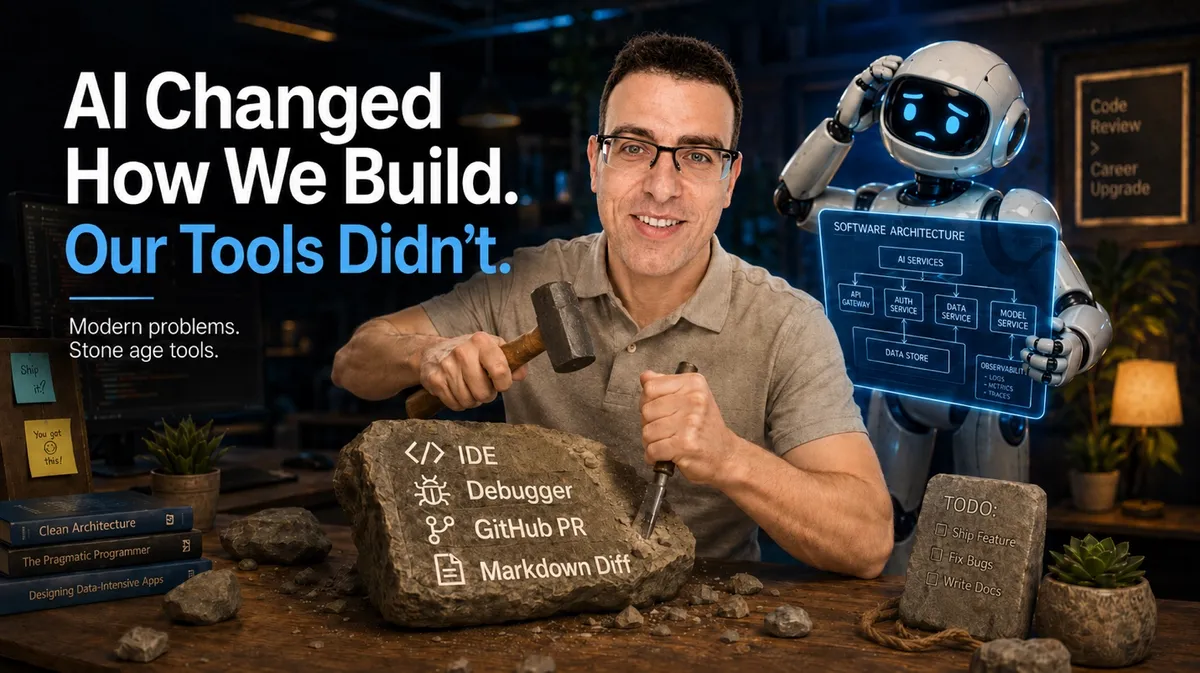
In the modern AI-driven SDLC, you use the agent through planning, design, implementation, testing, and operations, not just the coding in the middle. The steps themselves did not change, only the tools, the speed, and who, or what, does each part. Speaking of tools, they have not caught up with that shift, which I wrote about in AI Changed How We Build. Our Tools Didn’t.
Tooling gaps aside, the bigger adjustment is working with the agent itself. Some days it is that eager junior who needs tight direction and careful review. Other days it produces something close to a peer’s work, and the job becomes reviewing a fellow senior rather than babysitting a beginner. Either way, the skill that matters is judgment, knowing what good looks like and being able to spot where it went wrong - basically, being a real human in the loop.
The CEO of ClickUp captured the core change in a widely shared post:
The great engineers, the ones who can orchestrate, architect, and review, are becoming 100x engineers. They're not writing code. They're directing agents that write code. The skill is judgment.
Maybe the more accurate title is part AI orchestrator and part entrepreneur. Orchestrator, because the work is now directing and reviewing the agents that produce the code rather than producing it yourself. Entrepreneur, because deciding what is worth building, owning the outcome, and staying close to the customer used to be a founder’s job, and now it sits on the engineer’s desk too. With agents handling the building, a single person can own a product end to end in a way that only a founder could before, but only if they have the judgment to steer it, which is exactly where this gets hard for anyone who has not built that judgment yet.
The AI Vampire: Always-On Coding and Burnout
If the role is changing, so is the pace, and not always for the better. Marc Andreessen described it on the Joe Rogan Experience in a line shared on X that stuck with me:
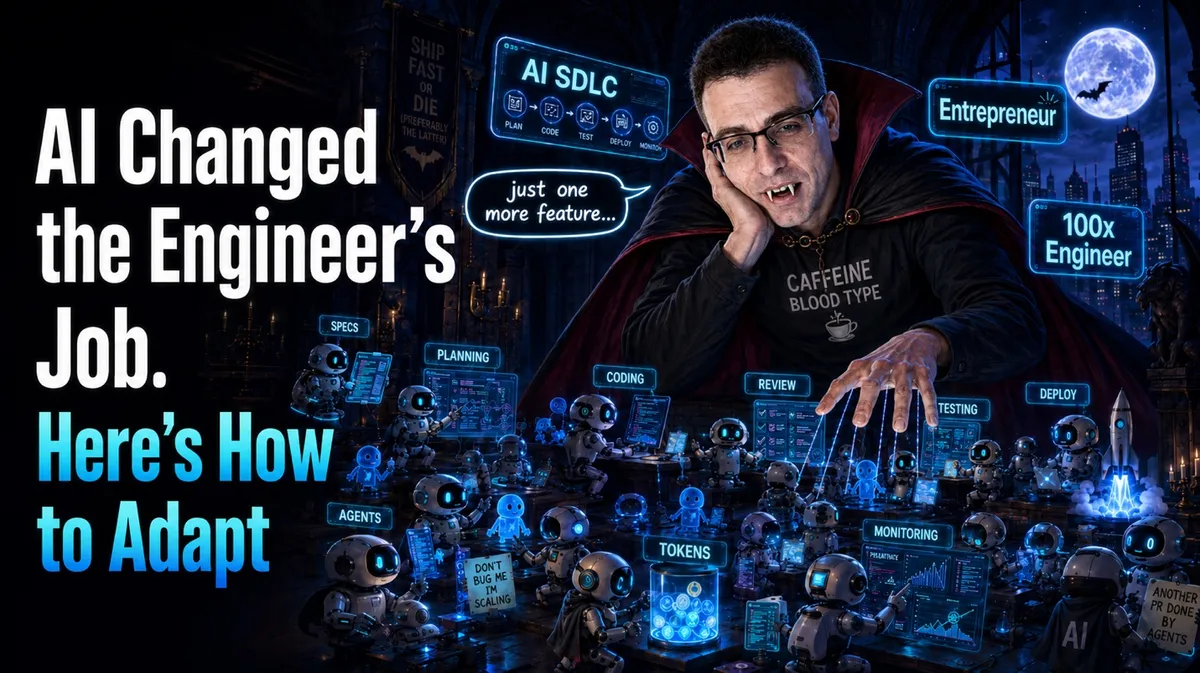
AI hasn't replaced coders. It turned them into vampires. The opportunity cost of going to sleep is too high because if you go to sleep, you won't be with your 20 AI coding agents.
It is funny until you realize how many founders and engineers are actually living it. When you can run twenty agents in parallel, every hour you are asleep is an hour they sit idle, and every hour a competitor’s agents are running is an hour they pull ahead. The pressure is brutal in a young startup, where you have no brand, and no customer loyalty yet. The only thing you can compete on is shipping the right features faster than everyone else, so you stay awake, you babysit the agents, and you push.
That is not sustainable, and pretending it is does real damage. People burn out. The founders who run this way start to demand it from their engineers too, and the stress compounds. The open question is whether the market balances itself out, or whether a wave of people simply leave the profession, some from burnout and some because the job stopped resembling the one they signed up for. Younger engineers may have an edge on raw stamina and fewer old habits to unlearn, but stamina is not judgment, and judgment, the thing this new world rewards most, is still the part that takes years to build.
The Real Cost of AI Coding: The Token Bill
If the vampire treadmill is the human cost of this shift, the token bill is the financial one, and it is arriving fast. Plenty of companies are pushing employees to use as much AI as possible. Amazon has reportedly urged staff to “tokenmaxx,” or burn as many tokens as they can, a pressure captured in this discussion, and Meta and Uber built internal leaderboards ranking teams by AI usage. The incentive is to consume more, so people do, sometimes on useful work and sometimes on whatever keeps them at the top of the dashboard.
Then reality hits. As Fortune reported, Microsoft has begun canceling most of its direct Claude Code licenses and steering engineers toward GitHub Copilot CLI instead, and Uber burned through its entire 2026 AI coding budget in four months. Nvidia’s Bryan Catanzaro put the new math plainly: “For my team, the cost of compute is far beyond the costs of the employees.” The uncomfortable twist is that cheaper tokens do not save you. Gartner expects per-token prices to fall sharply by 2030 while total bills keep climbing, because agents consume far more tokens per task and usage grows faster than unit prices drop.
Where a scrappy founder cannot afford to sleep, a large company cannot afford to let everyone run twenty agents around the clock, and plenty of engineers are caught between both pressures at once. This loops right back to the role. More code from more tokens is not progress if it floods your best people with output to review and lands you a compute bill larger than your payroll. The companies that win will not be the ones generating the most tokens. They will be the ones generating the right ones.
New AI Roles: Agent Managers and the 100x Org
Faced with both the burnout and the bill, companies are already redrawing the org chart. The clearest public sign of where this is heading came from that same ClickUp post, which announced a 22% headcount cut while claiming the business was the strongest it had ever been. The framing was a restructure around what the CEO calls a “100x organization,” built on fewer but far more highly paid people, with new roles like “agent managers” and salary bands reaching a million dollars a year for those who create outsized impact with AI.
Whatever you make of the specifics, the role map underneath is worth attention. Engineers become orchestrators and reviewers, product and design roles merge, a new class of agent managers owns the AI systems themselves, and front-line people who spend their time with customers become more valuable, not less, because human contact is the one thing agents cannot fake. Product people are being rewritten as much as engineers are. Now that code is cheap, a product manager or designer can build a proof of concept, mock up a real interface, and even open a pull request, leaving developers and agents to review the work rather than build it from scratch.
How Engineers Can Survive the AI Shift
So what do you actually do with all of this? Start by investing in the things that are getting more valuable, not less: judgment, product sense, and system design. Never outsource your understanding to the agent, learn to write clear specs and think in systems, and stay close to the customer, because time spent with real users is the one input no agent replaces.
Good engineering practice matters more now, not less. Code is almost free to produce, so the only thing between you and a pile of mistakes that look right is rigor. Trust nothing the agent outputs, even when it used a skill to get there. Test it, check that it does what the spec asked for, and review it as if a stranger wrote it. Testing fundamentals are critical than ever. I put together a guide to testing that describes the testing pyramid and the logic behind it long before agents arrived, and it has only become more relevant. In addition, the piece most teams are quietly skipping in the rush is governance and security, which is exactly the gap I wrote about in AI Didn’t Wait for Security.
It also helps to remember we have been here before. Developers have spent decades being asked to keep learning, object-oriented design, the cloud, SaaS, infrastructure as code, microservices, and an endless stream of frameworks. AI is the next item on that list, a bigger jump than most, but the constant holds: stay curious, keep your fundamentals sharp, and layer the new skills on top.
Be deliberate about how you pick those skills up. Skip the certificates, even the new AI certifications that vendors like Anthropic are now rolling out, because a badge teaches you very little about how any of this actually works. Learn by building instead. Take a project you actually care about and ship it end to end with agents, the way I did when I rebuilt my website with Claude in a few hours. You will learn more from one real project, dead ends and all, than from any course.
And protect yourself. The vampire pace is a trap dressed up as ambition, and nobody does their best reviewing or their clearest thinking on no sleep. Pace yourself, because this is a long shift, not a sprint.
The job is changing, and so must we.